7 min.By Paul RabenCo-Founder & Tech Lead
How to Use Open-Weight Models Without Your Own GPU
Open-weight models are cheaper per token and can keep your data yours. Here are the three ways to actually reach them, and how to pick the one that fits your team.
If you live in ChatGPT, Claude, or Gemini all day, you have probably heard that open-weight models are worth a look. You have also probably had no idea how to actually touch one. That gap is the whole problem. Nobody tells you how to use open-weight models in a way that is both cheap and safe, so most teams never try.
This is a plain guide to the three ways you can reach them, what each one costs, and what happens to your data with each. No hardware jargon, no GPU shopping list. Just the trade-offs, and a way to pick the one that fits your team.
What "open-weight" actually means
An open-weight model is one whose trained parameters (the weights, the actual numbers that make it work) are published for anyone to download and run. Llama from Meta, Mistral, DeepSeek, Qwen from Alibaba, and OpenAI's gpt-oss are all open-weight. You can put them on a machine you control, and nobody can switch them off or change the price on you.
People often call these open-source models, and mostly that is fine, but the two words are not identical. Open-source usually means the training code and data are public too. Open-weight just means the finished model is free to download. For picking a tool it rarely matters. What matters is that you are not locked into one vendor's closed API.
Two reasons open-weight models are worth the switch
Two things make them worth the effort: they cost less per token, and with the right setup your data stays with you.
On cost, the gap is not small. A McKinsey survey with the Mozilla Foundation of more than 700 technology leaders across 41 countries found teams save about 26% on average by using open source AI instead of proprietary tools. At the token level the difference is starker. Running a model like Llama or DeepSeek through an inference provider costs roughly $0.20 to $0.60 per million tokens, while GPT-4o sits around $5 to $15 per million. For a team pushing millions of tokens a month, that is the difference between a rounding error and a real invoice.
On data, the closed providers read what you send them, and some train on it unless you are on a plan that explicitly says otherwise. With an open-weight model set up correctly, your prompts and documents never leave for someone else's training set. That privacy case is why more than half of organizations now use open source AI somewhere in their stack, according to the same McKinsey research. If keeping prompts in-house is the goal, our guide to running a private AI server for sensitive data goes deeper on the how.
Three ways to use open-weight models
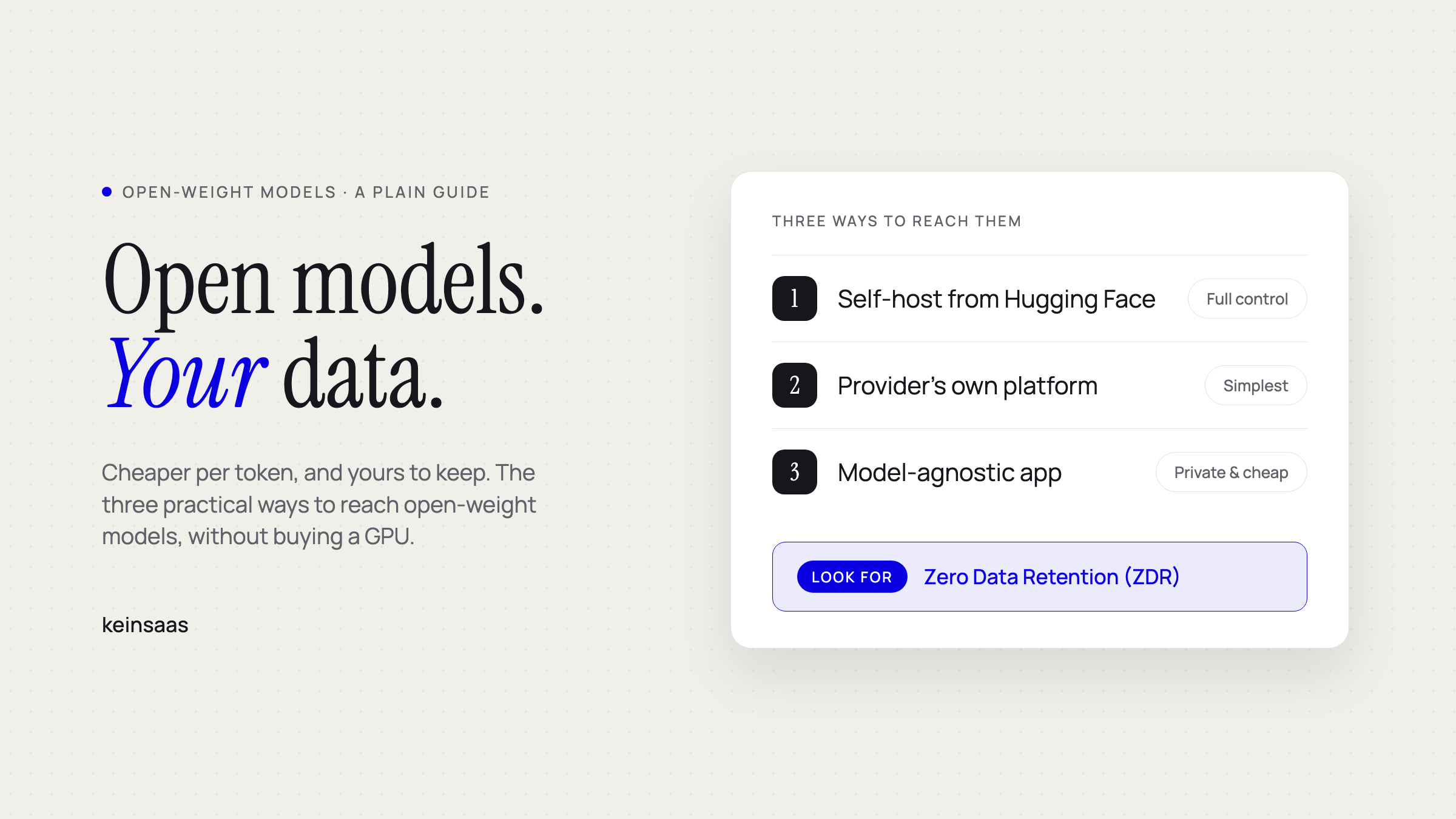
There are three practical routes. They trade off in the same two ways every time: how much work and cost you take on, and how much of your data you keep.
1. Self-host from Hugging Face
The most control, and the most work. You download the model from a hub like Hugging Face and run it on your own hardware or a rented cloud GPU. Nothing about your data ever leaves your walls. The catch is money and upkeep. A GPU that can run a mid-size model costs several thousand euros up front, or a cloud GPU runs a few hundred to a few thousand euros a month if you leave it on. Someone also has to keep it patched and running. For a small team that is a lot of fixed cost and babysitting. If self-hosting is genuinely on the table, we wrote a longer piece on running AI on infrastructure you control.
2. Sign up with the model's own platform
The simplest to start. Most open-weight models have a first-party API you can sign up for in minutes, and the token prices are low. It does not fix the data problem, though. Some of these providers still train on what you send, and several of the cheapest ones run their servers in places you may not want your client data sitting in. DeepSeek is the clearest example. Its own privacy policy says inputs can be stored on servers in China and used for training, which is why Italy's data protection authority banned the app. Cheap tokens, but you hand over the data to get them.
3. Use a model-agnostic app
One login, many models, nothing to host yourself. A model-agnostic app lets you switch between open-weight models (and closed ones) from a single interface, with no hardware to buy and no server to run. For most small teams this is the path to look at first. The one thing to check is the fine print on data. Some of these apps quietly pass your prompts back to the underlying providers. Some keep them private. The words to look for are Zero Data Retention (ZDR), which means nothing you send is stored or reused. If an app cannot tell you plainly that it offers ZDR, assume it does not.
| Path | Setup effort | Upfront cost | Data stays yours? | Best for |
|---|---|---|---|---|
| Self-host from Hugging Face | High | High (GPU or monthly cloud) | Yes, fully | Teams with in-house engineers and a hard privacy rule |
| Provider's own platform | Low | None | Often no (check training and jurisdiction) | Quick tests, non-sensitive work |
| Model-agnostic app | Low | None | Only if it offers ZDR | Small teams that want low cost and privacy without hosting |
How to choose
You do not need to weigh this for weeks. The decision comes down to one question: how much do you want to run yourself?
- Self-host if you have engineers to spare and a rule that data cannot leave the building.
- A provider platform if you are just experimenting and the data is not sensitive.
- A model-agnostic app with ZDR if you want the low cost and the privacy but do not want to run servers.
For most small and mid-size teams, the third option is the sweet spot: the token savings of open-weight models without a GPU to buy or a data policy to worry about. Smaller open models tilt the maths even further in your favour, which we cover in the economics of small language models.
Frequently asked questions
Are open-weight models cheaper than GPT-4 or Claude?
Yes, usually much cheaper per token. Running Llama or DeepSeek through an inference provider costs roughly $0.20 to $0.60 per million tokens, versus around $5 to $15 for GPT-4o. McKinsey put the average saving across a team's AI spend at about 26%.
Are open-weight models safe for business data?
They can be, but it depends entirely on how you reach them. Self-hosting keeps data fully in-house. A provider platform may train on your inputs. A model-agnostic app is safe only if it offers Zero Data Retention. Always confirm the data policy in writing before you send anything sensitive.
What is Zero Data Retention (ZDR)?
ZDR means the service does not store or reuse anything you send it. Your prompts and documents are processed and then gone, not logged and not fed into training. It is the single most important line to look for when you pick an AI app.
Do I need a GPU to use open-weight models?
Only if you self-host. Running a model on your own hardware needs a capable GPU. If you use a provider platform or a model-agnostic app, the hosting is handled for you and you need nothing but a browser.
What is the difference between open-weight and open-source models?
Open-weight means the finished model is free to download and run. Open-source usually means the training code and data are public too. In practice, for choosing a tool, the distinction rarely matters. Both free you from a single closed vendor.
Can I use open-weight models without sending data outside the EU?
Yes. Either self-host inside the EU, or use a model-agnostic app that runs on EU infrastructure and offers Zero Data Retention. That keeps both the compute and the data on your side of the border.
You are not behind
If all of this is new to you, you are not behind. Most teams are still on the default closed tools because switching looked complicated, not because they weighed it and decided against it. It stops looking complicated once you can name the three paths.
The third path is the one we built keinsaas Navigator around: EU and open-source infrastructure only, open-weight models with no data retention, and no hardware or GPU bills to think about. If you want to see whether that fits your team, you can learn more about how Navigator works.
So before your next AI subscription renews, one question is worth asking: do you actually know where your prompts go after you hit send?

About the author
Paul Raben
Co-Founder & Tech LeadIntegrated AI into products and automated manual work since GPT-2. Worked with several startups and Tech companies until he founded keinsaas to achieve real economic impact for Europe.
Connect on LinkedInWhat's next
Ready to build something that fits your team?
Book a free discovery call and we'll map out where custom AI would meaningfully change your week.
Book a discovery call