6 min.By Hagen RothmannCo-Founder & Commercial Lead
Your Sensitive Data Deserves a Private AI Server
Learn to deploy private AI servers for sensitive business workflows while ensuring data never leaves your control.

The Rise of the Private AI Server: Unlocking Business Value with Local LLMs
For business leaders in legal, HR, and finance, the promise of AI is often tempered by the risks of data exposure. Sending sensitive contracts, employee records, or financial statements to a third-party cloud service is a non-starter for many organizations bound by strict compliance mandates. The paradigm, however, has shifted. Deploying powerful large language models (LLMs) like Llama 3 or Mistral directly on company hardware is no longer a fringe technical experiment; it's a practical, secure, and powerful strategy for achieving data sovereignty in AI.
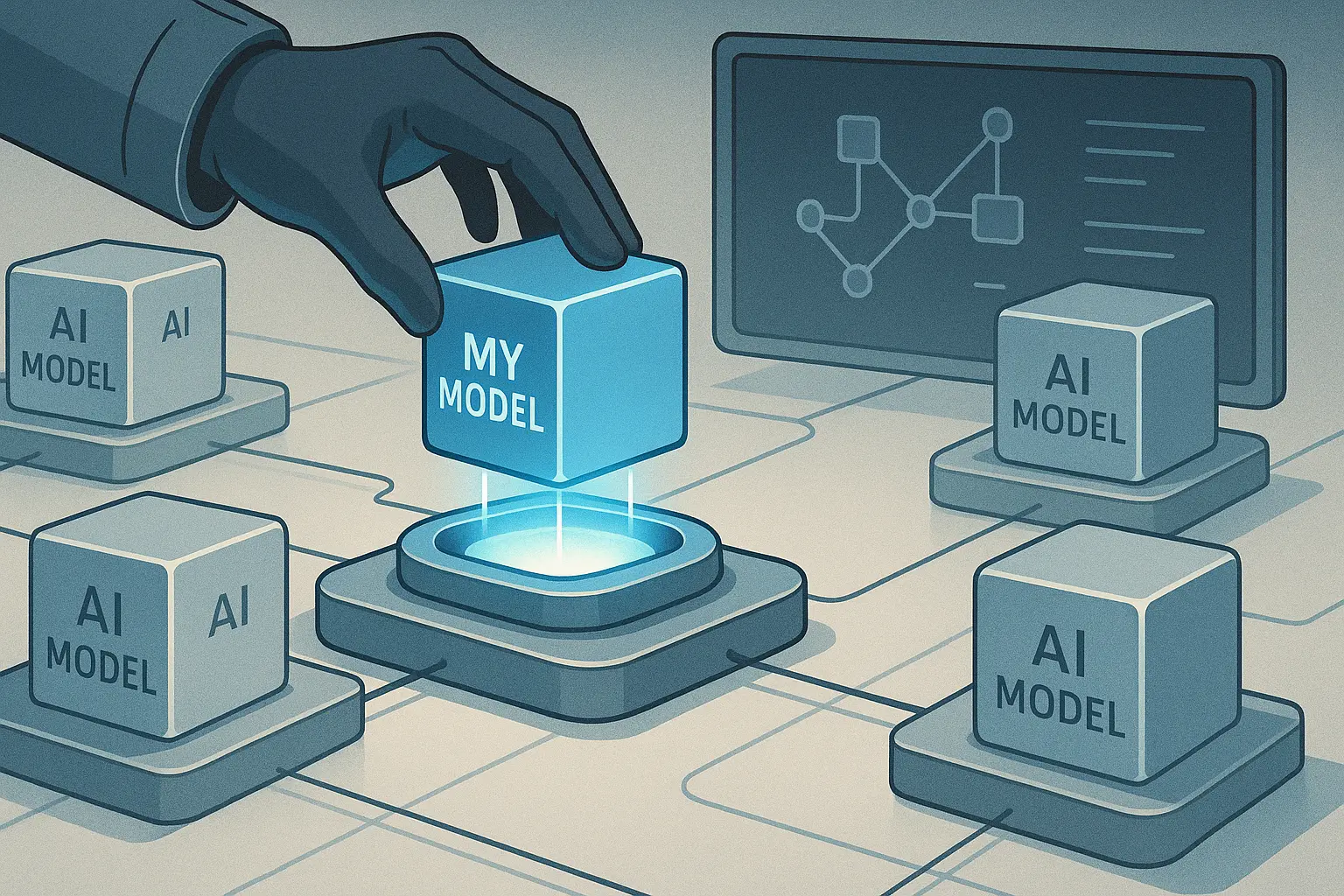
This move towards a private AI server architecture, even on a laptop, ensures that your most valuable data never leaves your control, offering a compelling alternative to the opaque policies of external API providers. This guide explores why and how businesses can leverage a local LLM for business to automate sensitive workflows safely and efficiently.
Why Data Sovereignty Demands a Local LLM for Business
The core advantage of running a local LLM is absolute control over data. When you use an OpenAI-style API, prompts and outputs are transmitted over the internet to third-party infrastructure, where they are processed and often logged, creating a significant compliance and security surface area (source). Even with contractual assurances, the risk remains.
In contrast, tools like Ollama and llama.cpp are designed for full local inference. The data remains on your device or internal network, ensuring it is never exposed to an external party (source). This architecture directly addresses critical business concerns:
- Regulatory Compliance: For legal, HR, and finance use cases involving personally identifiable information (PII), local deployment avoids cross-border data transfer issues, simplifying adherence to GDPR, CCPA, and internal data residency rules (source).
- Granular Control: You decide if prompts and completions are logged, how long they are retained, and where they are stored—be it a secure disk or your existing SIEM system—instead of relying on a vendor's opaque policy (source).
- Enhanced Security: Models can be deployed on encrypted drives, behind corporate VPNs or zero-trust architectures, and under your existing identity and access management (IAM) controls (source).
This level of control can be the deciding factor that enables AI adoption for highly sensitive workflows that would otherwise be too risky.
Choosing the Right Model: Llama 3, Mistral, and the Open-Source Edge
The open-source ecosystem has matured rapidly, offering models that rival the capabilities of closed alternatives while being freely available for commercial, on-premises use. Two families stand out for enterprise deployment.
Meta's Llama 3 is a robust choice for a private AI server. It offers strong general reasoning, excellent coding and summarization abilities, and is multilingual (source). Meta provides official documentation and reference code for running Llama 3 locally on developer hardware, including Windows machines (source).
Mistral AI's models, particularly the smaller and highly efficient variants like Ministral (3B parameters), are engineered for the edge. They run exceptionally well on consumer-grade GPUs or modern CPUs and support very long contexts—up to 128,000 tokens—making them ideal for analyzing large documents and contracts (source).
The prevailing trend is toward these smaller, optimized models (3B to 14B parameters) that deliver high performance with a smaller computational footprint, thanks to advanced quantization techniques (source). This makes them strong candidates for local LLM for business use on standard company laptops.
Practical Deployment: How to Run Llama 3 Locally with Ollama and Beyond
Deploying a local LLM can be approached in several ways, depending on the technical expertise of the end-user and the desired level of integration.
For Business Users: Turn-Key Desktop Applications
Tools like Nut Studio and LM Studio provide a user-friendly graphical interface similar to ChatGPT but with a crucial difference: everything runs locally. These applications automatically handle model downloads, hardware detection, and configuration, requiring no coding or command-line knowledge (source). They are ideal for pilots in departments like HR or Legal, allowing staff to perform tasks like document summarization or email drafting without data ever leaving their laptop.
For IT and Development Teams: Ollama for Enterprise
For seamless integration into custom applications and workflows, Ollama for enterprise use is the recommended path. Ollama runs as a background service on a local machine, exposing a simple REST API on port 11434 (source). Its command-line interface is incredibly simple—for example, `ollama run llama3.1`—and it manages model quantization and dependencies automatically (source).
The workflow is straightforward:
- Install Ollama on the target machine (Windows, macOS, or Linux).
- Pull the desired model: `ollama pull ministral:3b-instruct-q4_0`.
- Run the model and integrate with internal tools using the provided HTTP API (source).
This makes Ollama a strong foundation for building private AI server capabilities into existing business automation platforms.
Hardware Considerations and Operational Best Practices
You don't need a data center to get started. Modern laptops are surprisingly capable:
- CPU-Only (16GB RAM): Can efficiently run 3B-7B parameter models at lower quantization levels, suitable for text classification and short summaries.
- Mid-Range GPU (e.g., RTX 3060 with 8GB VRAM): Handles 8B-14B models comfortably, enabling more complex tasks like long-form analysis.
- Apple Silicon (M-series): The unified memory architecture is ideal for local LLMs, with an M1 Pro handling 3B models easily and an M3 Max capable of running 14B variants (source).
To ensure security, operate the LLM service only on internal networks or fully offline. Disable outbound connections for the LLM process to prevent any accidental data leakage. Integrate logging with your existing SIEM systems and apply standard security hardening like disk encryption and restricted admin rights.
Transforming Sensitive Workflows with Local AI
The practical applications are immense. Imagine a legal team using a locally run Mistral model with a 128k-token context to analyze lengthy contracts offline, extracting clauses and highlighting negotiation points. An HR department could deploy a local Q&A chatbot on a laptop, allowing staff to query internal policy documents without exposing employee data. Finance teams could use a local LLM to summarize quarterly reports or assist in writing complex financial models, all within a secure, controlled environment.
Conclusion: Taking Control of Your AI Future
The technology for deploying powerful, private AI on standard business hardware is here. By embracing local LLMs, organizations can finally use the transformative power of AI for their most sensitive workflows without compromising on data sovereignty or security. The shift from relying on external APIs to managing your own private AI server represents a strategic move towards greater operational autonomy and reduced compliance risk.
Are you ready to explore how a tailored local LLM for business can simplify your legal, HR, or finance operations? The team at keinsaas specializes in implementing custom, secure AI solutions that put you in control. Let's discuss how to build a future-proof AI strategy for your organization.

About the author
Hagen Rothmann
Co-Founder & Commercial LeadWith his first company, Coconaut.uk, he started automating processes in production and logistics early on. Today, he is driven by the question of how companies can handle recurring work more efficiently, autonomously, and at scale.
Connect on LinkedInWhat's next
Ready to build something that fits your team?
Book a free discovery call and we'll map out where custom AI would meaningfully change your week.
Book a discovery call