Automation vs AI Agents: When Each One Wins
The whole industry is pointed at agents. But most real work rewards the opposite. How we decide between a deterministic automation, a single agent, and a team of agents, task by task.
Every time we build something now, the first question is the same. Does this task need a deterministic automation, a single AI agent, or a team of agents working together? More often than not, the honest answer is the least exciting one. A plain automation.
That feels backwards right now. The whole industry is pointed at agents, and for good reason. But the automation vs AI agent call is the one most teams get wrong by default, because they reach for the agent before they have asked whether the task actually rewards one.
When an AI agent is the right tool
An agent earns its keep when a task is genuinely open-ended. When the steps can't be known up front, when new information shows up halfway through, when something has to make a judgment call and then change course, an agent is the right tool and nothing else is close. Research, triage, debugging, anything where the path branches on what it finds: hand it to an agent.
This is not a knock on agents. The model isn't the weak link. The mistake is putting one on work that punishes improvisation.
When a deterministic automation wins
A lot of real work isn't open-ended at all. It is the same sequence every time, with a correct output and a wrong one at each step. That is the home turf of automation: fixed inputs, fixed stages, a result you can trust without re-checking it by hand. When you already know the steps, building it as a structured AI automation is cheaper and far more reliable than asking a model to rediscover them on every run.
A worked example: building an outbound engine
Take the outbound engine we built for ecommerce vendors. The agencies and software vendors that sell to online shops need a steady supply of very specific prospects. The process is identical on every run:
- Set the ICP, so you know who actually counts as a fit.
- Find the shops that match it.
- Check each shop's traffic.
- Score its quality and revenue potential.
- Find and verify the decision-maker, with email and phone.
- Push the record into the CRM.
- Continue into hyper-personalized outreach.
Every step has a right answer and a wrong one. There is nothing to invent.
Hand that whole sequence to a single agent and it improvises exactly where you didn't want it to. It adds criteria that look relevant. It quietly loosens the filters when the list runs thin. The model isn't failing. It is doing what agents do, on a task that rewards the opposite.
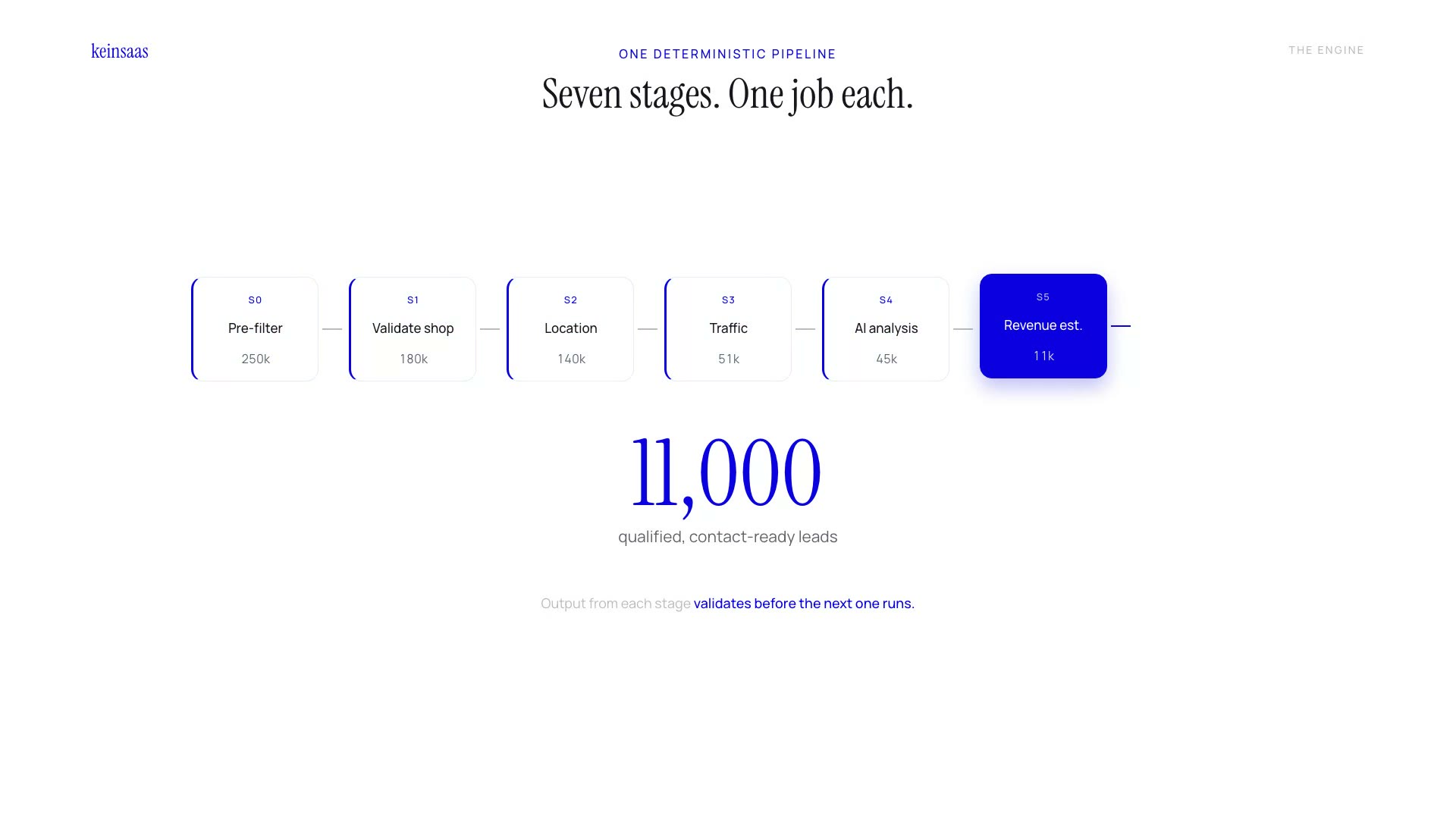
So we built it as a pipeline instead. Seven stages, each doing one job and checking its own output before the next stage starts. A shop that fails the traffic check never reaches the quality scoring. We still use AI inside the stages to read and judge messy data, but the structure around it is fixed, and every stage validates before it hands off.
What comes out is a list you can send from, not one you spend three hours cleaning first.
Agentic workflow vs AI agent
This is where the agentic workflow vs AI agent distinction matters, because the two get blurred constantly. Handing a goal to one autonomous agent and letting it decide every step is one thing. Building an agentic workflow is another: fixed stages, explicit checks, AI used only inside the boxes where judgment is genuinely needed. Both use models. Only one of them is predictable.
The more deterministic version isn't a downgrade. It is the difference between a system you can put in front of a client and a demo that works right up until it doesn't.
How to choose, task by task
A rough rule we keep coming back to:
- Use an AI agent when the steps are unknown, the path branches on what it discovers, or a person doing the same job would also have to think on their feet.
- Use a deterministic automation when the sequence is fixed, each step has a checkable output, and the same input should always produce the same result.
- Use a team of agents when the work is open-ended and large enough that one agent's context can't hold it, and the sub-tasks are genuinely independent.
Most real systems are a mix. The skill is drawing the line in the right place: agents on the open questions, automation on the parts that have to be right every single time.
Automation is not the past tense of AI
Being in the agentic era doesn't mean turning everything into an agent. The most reliable systems we ship today are more deterministic than the ones we built two years ago, not less. Look past the hype and the pattern holds: pick the simplest tool that makes the result repeatable. The models got better, so we trust them with the judgment calls and stop asking them to babysit the parts that were never ambiguous in the first place.
For a concrete version of this, the ecommerce lead engine is the same seven-stage pipeline from the video, running in production. It is the clearest example we have of automation and AI each doing the job it is actually good at.
Where do you draw that line in your own stack?

Paul Raben
Co-Founder & Tech LeadIntegrated AI into products and automated manual work since GPT-2. Worked with several startups and Tech companies until he founded keinsaas to achieve real economic impact for Europe.
Connect on LinkedInReady to build something that fits your team?
Book a free discovery call and we'll map out where custom AI would meaningfully change your week.
Book a discovery call