6 min.By Paul RabenCo-Founder & Tech Lead
How Small Teams Achieve Enterprise Efficiency with Back-Office Automation
Practical framework for small teams to implement back-office automation, from process mapping to scaling successes for maximum efficiency.

The Complete Guide to Back-Office Automation for Small & Mid-Size Teams
With tight budgets and stretched teams, back-office automation isn’t a luxury—it’s a strategic necessity for survival and growth. For decision-makers outside the tech bubble, the real challenge isn’t ambition; it’s navigating tool sprawl, complex jargon, and the fear of disruptive, expensive implementations. This guide cuts through the noise. We’ll walk you through the complete journey of automating your back-office—from mapping your first process to scaling your successes—using frameworks and examples tailored for resource-constrained teams. The goal is simple: to achieve enterprise-level efficiency without the enterprise-level complexity.
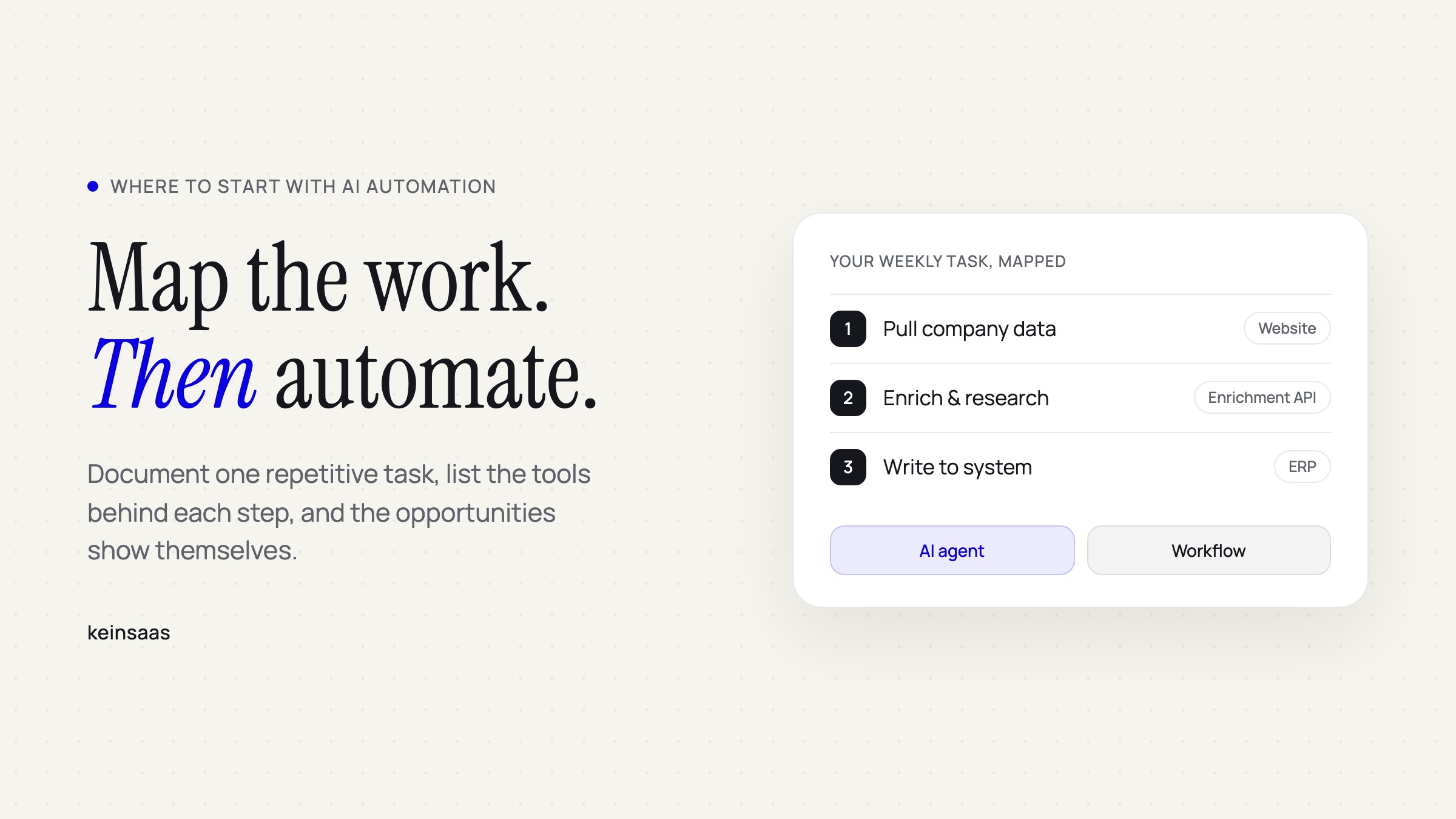
1. Process Mapping: The Critical First Step—Understanding Your "As-Is"
Automation built on a broken process only creates faster chaos. Your journey must begin with a clear, honest audit of your current workflows. This isn't about grand enterprise architecture; it's about simple documentation to uncover waste.
Framework: The 4 Stages of Process Automation A structured approach, as outlined in analyses of small advice firms, keeps you focused:
- Identify and Analyze: Map current workflows, noting time spent, errors, and handoffs between people or systems. (source)
- Design and Build: Sketch the automated version, but first, eliminate redundant steps manually. (source)
- Implement and Integrate: Start with a pilot in one contained area before scaling. (source)
- Monitor and Optimize: Track key metrics and continuously improve. (source)
Practical Steps for Your Team:
- Pick One High-Volume Workflow: Start with something like client onboarding, invoice processing, or employee setup. (source)
- Map It "As It Actually Is": Use a free tool like Lucidchart or even a whiteboard. Time each step. (source)
- Eliminate Before You Automate: Cut any step that doesn't add value. Automation should streamline, not cement, inefficiency. (source)
- Flag Rule-Based Tasks: Look for repetitive actions driven by clear rules: "If X, then do Y." These are prime automation targets. (source) (source)
| Step | Manual Time | Pain Points | Automation Potential |
|---|---|---|---|
| Collect client data | 15 min | Repetitive entry, errors | Form triggers + AI data extraction (source) |
| Run compliance checks | 10 min | Manual lookups across systems | Workflow triggers + API integrations |
| Update CRM & notify team | 5 min | Re-keying data, missed alerts | Auto-sync and notification rules |
| Total | 30 min | High error rate, low morale | Reduce to under 5 min |
Example: A small financial advice firm mapped client onboarding and found document collection and KYC checks consumed 70% of admin time. By automating these steps, they achieved immediate capacity gains. (source)
2. Identifying Your Automation Opportunities: Focus on Impact
Not every task should be automated. The key is to prioritize processes with a strong overlap of high impact and relative simplicity. Target high-volume, rule-based tasks that create bottlenecks.
Prime Back-Office Targets for Quick Wins:
- Client/Employee Onboarding: Automate form capture, welcome emails, CRM record creation, and task assignments. This is a universal pain point. (source) (source)
- Finance (AP/AR): Invoice reading, purchase order matching, and approval routing. AI can reduce processing time from several minutes to under 30 seconds with over 93% accuracy. (source) (source)
- Data Handling & CRM Sync: Extracting data from PDFs and emails to automatically update your central systems eliminates re-keying errors. (source)
- Compliance & Reporting: Automatically log activities and maintain audit trails, while retaining human oversight for critical reviews.
What to Avoid Initially: Tasks requiring deep strategic judgment, unstructured creative work, or processes that change daily.
The 2026 Landscape: AI Agents and Democratized Tools The trend is shifting from automating isolated tasks to implementing agentic AI that can manage end-to-end workflows, like processing an invoice from receipt to payment. (source) At the same time, no-code/low-code platforms have democratized access, allowing non-technical teams to build powerful automations. The debate often centers on control versus convenience: open-source solutions offer data control, while paid enterprise suites provide advanced governance. (source) For most small teams, the winning strategy is to start with quick wins on flexible platforms to build momentum and ROI.
3. Choosing the Right Approach: No-Code, RPA, or AI Agents?
Your choice of tool should match your team's skills, budget, and the complexity of the task. Here’s a simplified breakdown:
| Approach | Best For | Pros | Cons | Examples |
|---|---|---|---|---|
| No-Code Workflow Builders | Quick wins, marketing/sales/ops teams | Visual drag-and-drop, fast setup, hundreds of app integrations | Can be limiting for highly complex, custom logic | Platforms like Activepieces offer free tiers and templates. (source) |
| RPA + AI | Document-heavy, repetitive tasks (invoices, forms) | Excellent at mimicking human actions in legacy software, strong data extraction | Can have a steeper learning curve; requires clearer process rules | UiPath offers user-friendly studios for building software bots. |
| AI Agents | End-to-end processes requiring decision-making | Can handle multi-step workflows with "human-in-the-loop" checkpoints | Higher cost and requires more mature, well-defined processes | Emerging solutions tailored for specific verticals like retail and finance. (source) |
Our Recommendation: Start with a versatile no-code platform that can connect your existing tools (CRM, email, accounting software). That lets you prove value quickly and create a foundation you can build on. Integrate RPA or specialized AI for specific document-heavy tasks as you scale. (source)
4. Calculating Tangible ROI: Beyond Time Saved
To secure buy-in, you must quantify the value. The basic formula is: ROI = (Time Saved × Hourly Rate × Volume - Tool Cost) / Tool Cost.
Industry benchmarks are compelling: retail back-offices have seen an average ROI of 544% from automation, with 75% of businesses realizing positive returns within 12 months. (source)
Simple ROI Framework:
- Establish a Baseline: e.g., Client Onboarding takes 30 minutes. You do 5 per day. Staff cost is $50/hour. Daily cost: (0.5 hrs × 5 × $50) = $125.
- Estimate Post-Automation: Reduce the task to 5 minutes (83% time savings). New daily cost: ~$21.
- Annualize the Savings: Daily savings of $104 × 250 working days = $26,000 saved per year.
- Factor in Intangibles: Add the value of reduced errors (e.g., 93% accuracy in invoice processing), improved compliance, faster turnaround times, and boosted employee morale by removing tedious work. (source)
5. Measuring Success and Scaling with Confidence
Launching an automation is only the start. To ensure lasting value and justify further investment, you must measure its performance.
Key Metrics to Track:
- Time Reduction per Process: Target an 80%+ reduction in manual handling time. (source)
- Error/Rework Rate: Track the drop in mistakes from manual data entry or missed steps.
- ROI Realization: Compare actual savings and cost avoidance against projections.
- Team Feedback: Gauge the increase in capacity and improvement in team focus on strategic work.
Use the monitoring dashboards in your automation platform (like UiPath Orchestrator or built-in logs in no-code tools) to track these KPIs. Optimize iteratively. Review performance quarterly and expand automation to the next priority process on your list.
Real-World Scaling Path: A small firm automated their Letter of Authority processing first, achieving perfect data accuracy and CRM sync. This quick win built internal momentum and a scalable foundation, allowing them to confidently tackle compliance reporting next. (source)
Conclusion: Your Path to Lean, Intelligent Operations
Back-office automation is no longer a frontier reserved for large corporations with IT departments. It is a pragmatic, step-by-step methodology for any business leader seeking resilience and growth. By starting with a single mapped process, choosing the right lightweight tools, and measuring tangible outcomes, you can unlock significant capacity, reduce operational risk, and empower your team to focus on what truly drives your business forward.
The journey from manual, error-prone workflows to streamlined, intelligent operations begins with a single decision to investigate. The frameworks and examples here provide your roadmap. The next step is to apply them to your unique context.
Ready to map your first process and identify your automation quick win? Explore how strategic automation can be tailored to your existing stack and goals. Discover a more intelligent approach to operations.

About the author
Paul Raben
Co-Founder & Tech LeadIntegrated AI into products and automated manual work since GPT-2. Worked with several startups and Tech companies until he founded keinsaas to achieve real economic impact for Europe.
Connect on LinkedInWhat's next
Ready to build something that fits your team?
Book a free discovery call and we'll map out where custom AI would meaningfully change your week.
Book a discovery call