5 min.By Hagen RothmannCo-Founder & Commercial Lead
Why Most AI Projects Fail and How to Succeed in 2026
A practical guide to avoiding AI implementation failures and achieving measurable ROI through strategic workflow redesign.

95% of AI Investments Fail. Here’s Why 2026 Changes Everything.
Let’s be direct. The AI hype cycle is winding down. The era of experimentation, fueled by hype and FOMO, is closing. In 2026, CFOs are taking the wheel. They are demanding more than cool demos. They want a clear, measurable return on investment. The uncomfortable truth is that 95% of AI projects fail to deliver any tangible ROI. Not because the technology is bad, but because companies are using it wrong. They are simply automating broken workflows instead of redesigning work itself. Here’s how to do it right.
Why Your AI Project Will Probably Fail (And How to Avoid It)
Most companies repeat the same critical mistakes. They are predictable and entirely avoidable.
Tool Shopping Without a Strategy
This is the most common failure pattern. A team signs up for seven different AI tools. One for writing, one for coding, one for data analysis. None of them talk to each other. The result is zero integration, more complexity, and no meaningful impact. You have added cost and chaos, not capability.
Chasing Shiny Objects Instead of Back-Office Wins
Everyone wants the flashy customer-facing chatbot. But the real goldmine is in your internal operations. Automating invoice processing, HR onboarding, or sales reporting delivers a 3x better ROI. These processes are repetitive, rule-based, and ripe for automation. Start where the money is, not where the headlines are.
Deploy and Forget
You launch a pilot. It works for three months. Then it breaks. Why? Because you didn’t build feedback loops. AI systems are not fire-and-forget missiles. They need monitoring, tuning, and human oversight. Without it, they degrade quickly and become useless.
Treating AI as a Threat
If you frame AI as a replacement for your team, you guarantee low adoption. The pilot will die quietly because no one uses it. The winning strategy is to position AI as leverage. A tool that frees your people from drudgery so they can focus on high-value work.
No Link to Business Outcomes
After 18 months, you can’t prove the value. Why? You never defined what success looks like. If you can’t connect the AI project to a key metric like cost savings, revenue growth, or time reduction, you will never be able to justify the investment.
The Three Strategic Shifts You Must Make in 2026
Success in 2026 requires a fundamental change in mindset. It’s not about better tools. It’s about a better approach to work.
1. From Tools to Autonomous Workflows
Stop thinking about single tasks. Start thinking about entire workflows. The difference is "write this email" versus "handle the entire customer outreach workflow end-to-end." Gartner predicts that 40% of enterprise applications will have autonomous workflows built in by 2026. The impact is real. We see 30-50% process acceleration and a 60% reduction in manual work when you automate a complete workflow, not just a step.
2. From Models to Data
The AI models themselves are becoming commodities. Their cost has dropped 10x in the last 18 months. Your competitive advantage is no longer the model. It’s your proprietary data. A generic AI thinks "dressing" is a salad. A hospital’s AI, trained on its own data, knows it’s a wound dressing. Domain-specific models are more accurate, cheaper to run, and easier to govern because they speak your business language.
3. From Pilots to Workflow Redesign
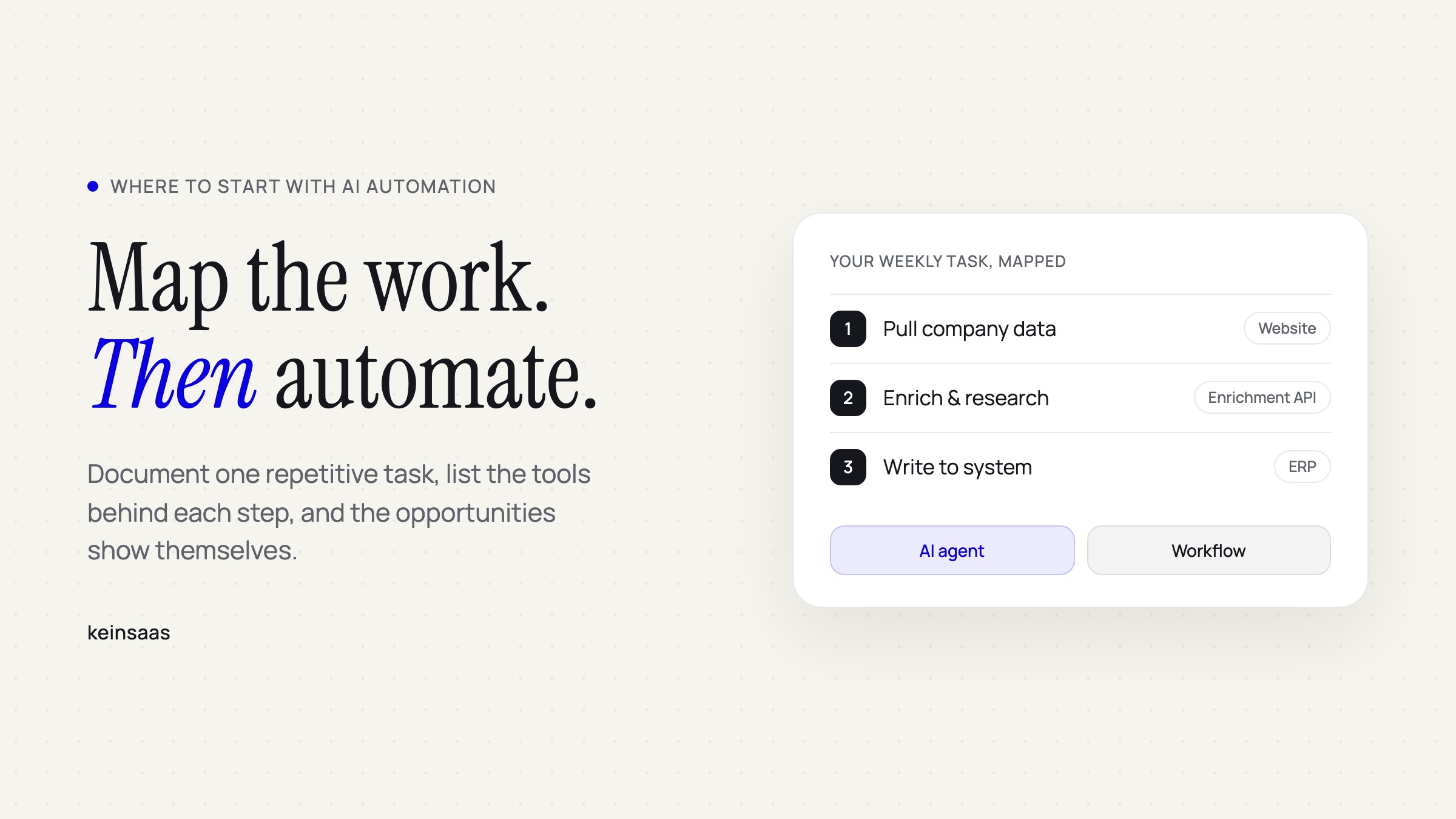
Pilots fail because they happen in a controlled environment that doesn’t reflect real work. Success requires a seven-step workflow transformation process. The critical pattern is to start with internal processes, not customer-facing ones. Redesign the work first, then apply the technology. This is the only way to achieve sustainable change.
The Technical Reality: A Four-Layer Architecture That Works
Set aside the jargon. Your AI infrastructure needs four simple, robust layers.
Layer 1: Make Data Findable. This is the foundation. Implement semantic search and multimodal capability so your systems can find and understand all your information, whether it’s text, spreadsheets, or images.
Layer 2: Model Flexibility. Don’t bet on one model. Use smart routing to send tasks to the most cost-effective model. This alone can cut your AI operational costs by 30-75%.
Layer 3: Standardized Integration. Use protocols like MCP (Model Context Protocol) instead of building 50 custom connectors. Standardization is the key to maintaining speed and avoiding technical debt.
Layer 4: Governance That Enables Speed. Governance should be about guardrails, not roadblocks. Build in safety, security, and compliance from the start so you can move fast without breaking things.
Build vs. Buy vs. Partner: The Cold, Hard Math
You have three options. Only one makes financial sense for most companies in 2026.
The SaaS Trap: Buying off-the-shelf tools leads to vendor lock-in, zero flexibility, and a subscription treadmill. You get what they give you, and you never own the system.
The In-House Reality: Building yourself takes 12-18 months and costs €120,000 to €200,000+ just for talent. Then you face 30-50% of that cost annually in maintenance. It’s slow, expensive, and diverts your team from core business goals.
The Partnership Model: Working with an expert partner gets you to a working system in 90 days. You get knowledge transfer, not dependency. Most importantly, you own the system. It’s built on your stack, with your data, for your goals.
The 120-Day Roadmap: From Zero to ROI
This is not a theoretical plan. This is a high-level execution timeline we use with clients.
Phase 0 (Weeks 1-2): Process mapping and baseline metrics. You must know where you are starting from to measure success.
Phase 1 (Days 15-45): Prove value with one department. Target saving 10+ hours per person per week. This builds immediate credibility.
Phase 2 (Days 45-90): Add security layers and expand to 2-3 more departments. Scale what works.
Phase 3 (Days 90-120): Company-wide rollout. By this point, the system should have already paid for itself.
Measuring Real ROI: The Formula Your CFO Wants
Skip vague promises. Use this four-quadrant framework: Financial, Operational, Strategic, and Risk Mitigation. The financial formula is simple and powerful.
Monthly Savings = (Time Savings + License Savings) - (LLM Costs + Infrastructure Costs)
Your target. Payback in under 6 months, positive ROI by month 12. For example, if you save 100 hours per month at an internal cost rate of €75 per hour, that’s €90,000 per year in hard savings. That’s before you even count the operational and strategic benefits.
Common Pitfalls to Sidestep
Knowing what not to do is as important as knowing what to do.
Starting Too Big: Don’t try to transform the entire company. Transform one process in 90 days. Win small, then scale.
Technology Before Problems: Never choose a technology, like a vector database, before you have identified the business problem it will solve.
Forgetting Data Quality: AI amplifies the "garbage in, garbage out" problem. Clean, structured data is non-negotiable.
Underestimating Change Management: Frame AI as leverage for your team, not as a replacement. Adoption is everything.
What’s Real vs. Hype in 2026
Let’s separate reality from hype.
Real: Multimodal AI is standard. Autonomous workflows work and deliver massive efficiency gains. Cost compression for AI models will continue.
Hype: AGI (Artificial General Intelligence). AI replacing the entire workforce. Fully autonomous companies with no human oversight.
The Three Decisions That Matter
Your success in 2026 boils down to three simple but critical choices.
1. Process first, technology second. Redesign the work, then automate it.
2. Own what matters, rent what doesn't. Own your data and your core workflows. Rent commodity technology.
3. Measure ruthlessly. If you can’t measure it, don’t build it.
The window for casual AI experimentation is closed. In 2026, you either implement a disciplined, ROI-driven strategy or you get left behind. The path to success is clear.
Want the complete blueprint with technical architecture details, ROI formulas, and the full 120-day implementation roadmap? Download our free whitepaper 'AI Strategy 2026: A Blueprint for Implementation That Works' at help.keinsaas.com/knowledge.

About the author
Hagen Rothmann
Co-Founder & Commercial LeadWith his first company, Coconaut.uk, he started automating processes in production and logistics early on. Today, he is driven by the question of how companies can handle recurring work more efficiently, autonomously, and at scale.
Connect on LinkedInWhat's next
Ready to build something that fits your team?
Book a free discovery call and we'll map out where custom AI would meaningfully change your week.
Book a discovery call