AI Automation 2026: Which Tools You Really Need (and Which You Don't)
A practical guide to AI automation in 2026: how to choose the right tools in an agentic world, common mistakes, and the two layers (process and employee) every company needs to build.
What is AI Automation?
Most articles about AI automation still explain RPA, machine learning, and the evolution from one to the other. Correct, but irrelevant. The market has shifted since 2024. Language models use tools autonomously, build workflows, correct themselves. The right question today is no longer "What do we automate?", but "Which tools do we choose, and who builds what with them?".
This article answers that pragmatically, without platform marketing.
What is AI Automation?
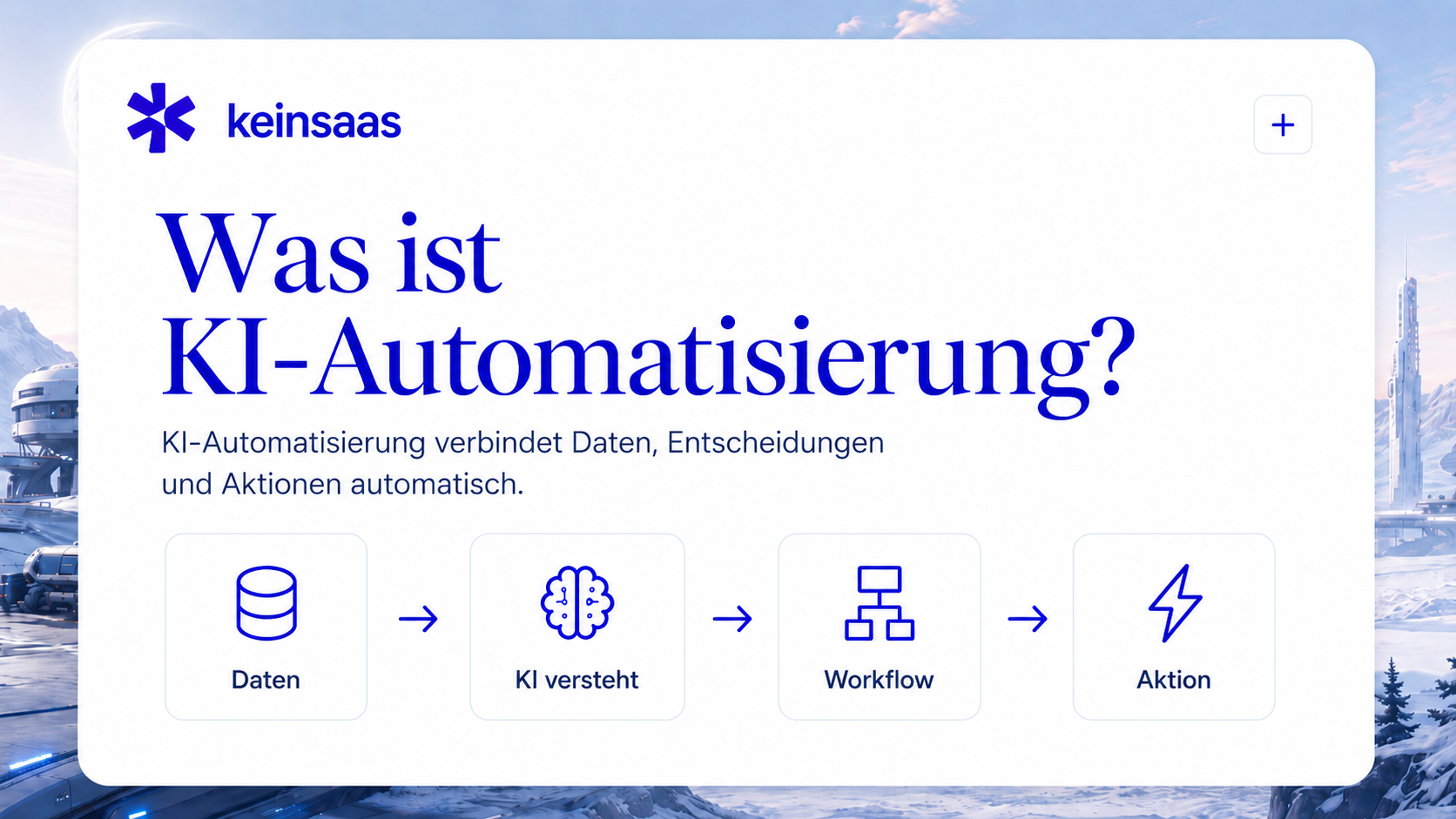
AI automation combines artificial intelligence with process automation. Unlike classic automation, it does not follow rigid rules. It understands context, makes decisions, and adapts to new data.
Three generations are running in parallel today:
Generation 1: Rule-based Automation (RPA) Bots repeat defined tasks. Invoice intake, form processing, data migration. Still works well for stable processes with structured data.
Generation 2: ML-driven Workflows Models classify data, make predictions, or detect anomalies. Embedded into workflow systems. Examples: spam filters, fraud detection, demand forecasting.
Generation 3: Agentic AI Language models plan tasks autonomously, call tools, check results, and adjust. They replace fixed workflows with dynamic decision chains. This is where the actual shift has been happening since 2024.
The point: anyone who understands AI automation only through Generations 1 and 2 is missing where the market is today.
What Agentic AI Actually Changes
Classic automation works like this: you describe every step in detail. If something does not fit the schema, the process breaks.
Agentic automation works differently. You describe the goal. The system finds the path, calls tools, checks intermediate results, corrects if needed.
Three technical drivers behind it:
1. Reasoning models reach business readiness GPT-5, Claude Opus 4.x, and Gemini 2.5 Pro have reasoning capabilities sufficient for most business processes. What was buggy and unreliable in 2023 is production-ready for clearly scoped tasks in 2026.
2. Tool use via MCP standardizes connectivity The Model Context Protocol (MCP) and similar standards make it trivial to connect AI agents to any system. What was custom integration two years ago is plug-and-play today. One MCP server for your ERP, one for your CRM, and every agent can use both.
3. Workflow generators build automations themselves Tools like our keinsaas Navigator create automations from natural language. You describe what should happen. The system builds, tests, fixes, ships. The Build-Test-Fix logic is what separates this from the first generation of no-code tools like Make, Zapier, or n8n.
The New Toolchain for AI Automation
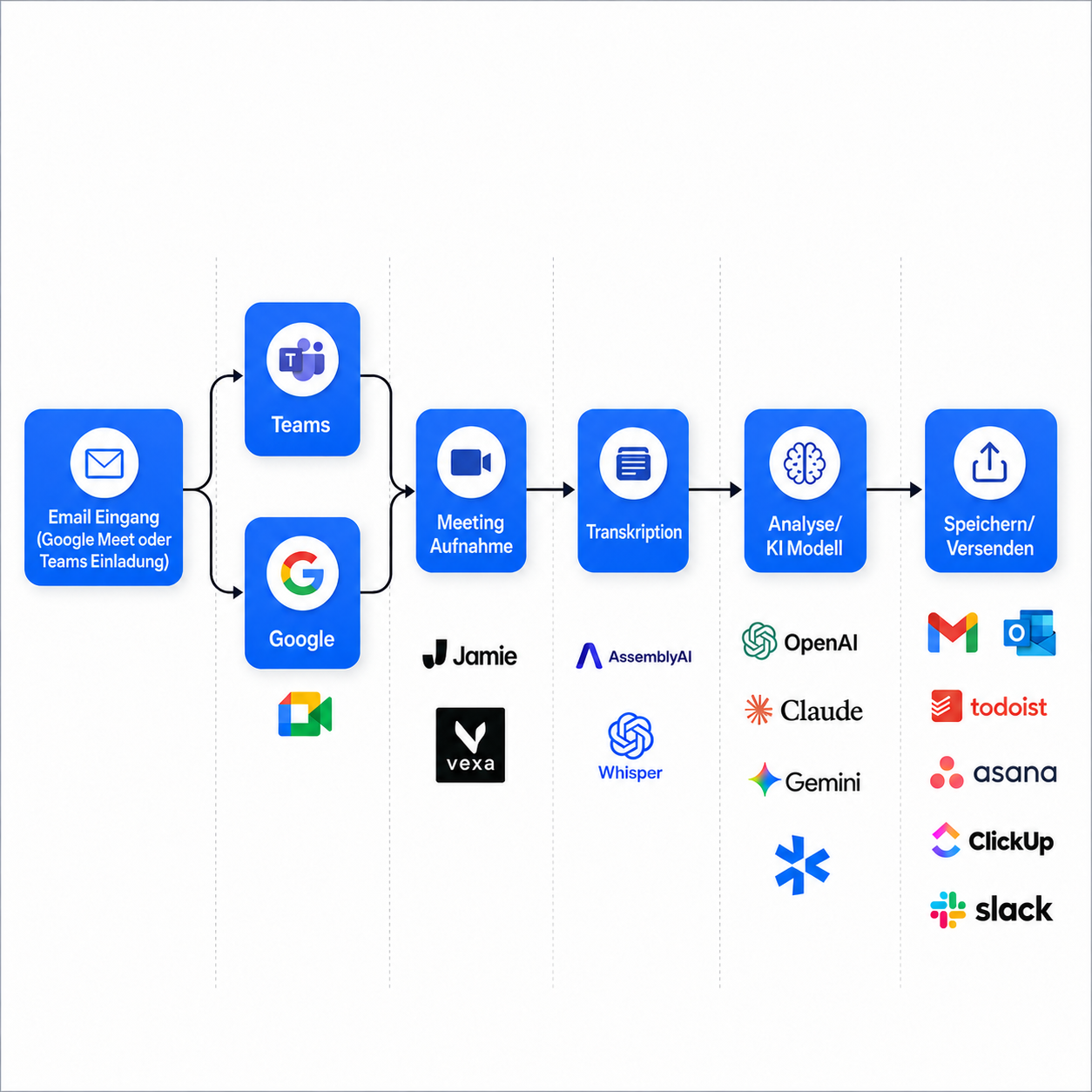
The 2026 tool landscape can be grouped into five layers. Each one needs a conscious decision.
1. LLM Layer (Foundation Models)
No single model is better everywhere. Choose by task:
- OpenAI (GPT-5, GPT-5 mini): solid all-rounder, good tool use, broad ecosystem
- Anthropic Claude (Opus 4.x, Sonnet 4.x): strong on complex reasoning and long contexts
- Google Gemini (2.5 Pro, Flash): cost-efficient, good for volume tasks
- Open-source (Llama, Mistral, Qwen): when data sovereignty or self-hosting is required
Decision criteria: reasoning depth, latency, price, EU hosting. Routing between multiple models depending on the task is standard in 2026, not the exception.
2. Orchestration Layer
This is where steps are chained, conditions checked, errors handled:
- n8n: open-source, very flexible, good for complex custom workflows. Self-hostable.
- Make or Zapier: quick to start, but expensive at scale
- LangGraph, LlamaIndex Workflows: code-based, full control, for dev teams
- Workflow generators like keinsaas Navigator: build workflows from language, ideal when dev resources are scarce
3. Tool Connectivity (MCP, APIs)
MCP servers are the 2026 standard for agent-to-tool communication. Instead of 50 individual integrations, you build one MCP server per internal system. Every agent in the company can then use it. Setting standards early avoids vendor lock-in later. A curated overview of the most important MCP servers is available in our MCP Server List 2025.
4. Memory and Context
- Vector databases (Pinecone, Weaviate, pgvector, Qdrant): for semantic search and Retrieval Augmented Generation
- Classic databases (Postgres, Supabase): for structured data
- Data lakes (Snowflake, BigQuery, Databricks): for analytical workloads and larger volumes
5. Frontend and Agent Layer
- Voice agents (ElevenLabs, Vapi, Bland): telephony automation for customer service or dispatch
- Chat-embedded (custom widgets, Intercom Fin): customer service and internal assistants
- Browser agents (Operator, Computer Use): UI automation where no API exists
How to Choose the Right Tools
Three questions decide more than any feature comparison.
Question 1: Process or Employee?
Is it a corporate process that runs recurringly at high volume (invoice processing, lead routing, master data maintenance)? Then a dedicated workflow with monitoring, error handling, and governance is worth it.
Is it the task of a single person or small team (reporting, email triage, research)? Then a simple agent with tool access is often the better solution. Faster to build, closer to the user, no translation loss.
This difference is not trivial. Platforms like Salesforce Agentforce or ServiceNow squeeze everything into the process model. That works for the top 50 processes but ignores the 5,000 small activities that happen daily in a company.
Question 2: Deterministic or Probabilistic?
For accounting, compliance, or regulatory processes, you need deterministic results. Here AI is a co-pilot that suggests, not an autonomous agent. Final control stays with humans.
For customer communication, research, or content creation, probabilistic is fine. Agents can work autonomously here, as long as a human-in-the-loop exists for critical cases.
Question 3: Self-hosted or Cloud?
Self-hosted makes sense when there are GDPR concerns with cloud LLMs, when data cannot leave the company, or when volumes are so large that cloud LLMs become uneconomical.
Cloud makes sense when implementation speed matters, when no infrastructure is in place, and when workloads vary.
For most DACH mid-market companies, cloud with EU hosting is the pragmatic starting point. Anthropic, OpenAI, and Google all offer EU regions. Self-hosting comes later, once use cases are stable.
Common Mistakes in Tool Selection
Mistake 1: Thinking tool-first, not problem-first "We want to use ChatGPT or Agentforce, what can we do with it?". Wrong order. Define the problem first, then choose tools. Otherwise, you end up with pilot projects without ROI.
Mistake 2: Forcing everything into one platform Salesforce, ServiceNow, and similar vendors sell platform lock-in. Sounds safe, costs flexibility and money long term. Polyglot stacks (different tools for different problems) are often the more realistic choice in 2026, especially for SMEs.
Mistake 3: Starting without a data foundation An AI agent without access to clean data produces garbage. First clean up data, then automate. Anyone doing it the other way around wonders why they get hallucinated results.
Mistake 4: Over-engineering Multi-agent setups with five sub-agents for a task that a simple workflow would handle. Add complexity later, not from day one.
Mistake 5: Ignoring the employee Top-down automation driven by IT, without asking the employee who knows the process. Result: translation loss. The employee knows how the process runs, but the built solution doesn't fit.
AI Automation by Industry
E-Commerce
- Product data maintenance (image classification, description generation, translation automation)
- Customer service agents for standard inquiries, returns, shipping status
- Order data sync between shop, ERP, and shipping
- Dynamic pricing based on competition and stock
- Review and reputation monitoring
Software Companies
- Code review agents for pull requests
- Support ticket routing and first responses
- Documentation maintenance generated from code
- Customer onboarding sequences
- Sales outreach with personalized sequences
SMEs in General
- Email triage and template responses
- Quote and invoice creation from templates
- CRM maintenance from email correspondence
- Reporting from multiple data sources
- Supplier and customer communication
Construction and Architecture
- Tender processing, GAEB data extraction and classification
- Reusing text blocks from historical projects
- Measurement documentation from photos or PDFs
- Compliance checks for standards and building regulations
- Quote calculation based on historical projects
Media
- Content research and source verification
- Translations and localization into multiple languages
- Social media distribution with channel-specific formatting
- Archiving and automatic tagging
- Transcription and summarization of interviews
Important: none of these use cases necessarily needs a Salesforce or ServiceNow license. Most can be built with n8n, an LLM API, and MCP servers for internal systems. At a fraction of the cost.
The Future: Two Layers of AI Automation
Over the next 24 months, AI automation will develop on two layers in every company. Both are needed, both require different tools.
Layer 1: Corporate Processes
This is about central, recurring business operations at high volume. The prerequisite is not AI, it's data.
What needs to happen:
- Build data lakes: consolidate data from ERP, CRM, shop, accounting, and logistics into a unified data space
- Prepare data: harmonize schemas, remove duplicates, keep master data clean
- Make data accessible to AI: via MCP servers, APIs, and vector databases
Only then do agents on the process layer become genuinely useful. Until then: garbage in, garbage out. This is exactly where many AI initiatives in 2024 and 2025 fail. The technology is bought, but the data foundation is missing.
Layer 2: Employees
This is where the biggest unrecognized leverage sits. Every knowledge worker has manual tasks that recur, but are too small for IT to justify an official workflow.
Three things are new in 2026:
No more translation loss. The employee describes themselves what they need. No spec document handed to IT that loses details while being written. No briefing meeting where half the requirements drop.
No technical skills required. Language-based workflow generators build the automation. The employee says in normal language what should happen. The system translates that into an executable automation.
Costs are down. Where a custom automation used to cost 10,000 to 20,000 euros, in 2026 it's a few hundred euros per month for a subscribed tool. The economic threshold for an automation to be worth it has dropped drastically.
Consequence: thousands of small automations spread across the company, instead of a few large workflow projects. The cumulative efficiency gain is significantly higher than under the classic top-down logic.
How keinsaas Delivers on Both Layers
We build for both layers, because one does not work without the other. Everything runs inside our open-source AI workspace beta.keinsaas.com. Auditable, forkable, self-hostable.
For simple tasks on the employee layer: build your own agents
Employees assemble their own agents in the workspace. Connected to email, CRM, calendar, and internal tools via MCP. No IT ticket. No waiting. With full data control, because EU-hosted or self-hosted.
For complex automations: Workflow Generator
You describe the process in normal language. The agent builds the automation. Our team reviews it before it goes live. The Build-Test-Fix loop ensures the automation works on the first attempt in 95 percent of cases. No weeks of customization, no blind trust in an agent.
Both layers complement each other. Data and processes from the top, agents and micro-automations from the bottom. Anyone serving only one layer leaves most of the available leverage on the table.
Conclusion
The 2026 question is no longer "AI automation, yes or no". It is: which tools for which layer, and who builds them?
Anyone still reading RPA comparisons and generational evolution explainers is three years behind. Anyone investing in closed platforms like Salesforce Agentforce or ServiceNow is buying comfort against lock-in. Both can be right, but rarely are they the most economical choice for a DACH mid-market company.
Pragmatic middle path for most companies: polyglot tool selection, EU-hosted LLMs, MCP for connectivity, workflow generators for speed, and your own employees as the main source of automation ideas.
If you want to see what this looks like in your company: build your own agents or generate workflows at beta.keinsaas.com.
Frequently Asked Questions about AI Automation
What is the difference between AI automation and classic automation? Classic automation follows rigid rules. AI automation understands context, makes decisions, and adapts. RPA bots can process invoices when the format stays the same. An AI agent also handles new formats and edge cases.
Which industries benefit most from AI automation? Industries with a high share of recurring knowledge work benefit fastest. E-commerce, software companies, architecture firms, media organizations, and SMEs with administrative processes typically see efficiency gains within weeks. Construction and industrial companies often take longer because the data foundation has to be built first.
What does AI automation cost in 2026? Individual employee agents often run 50 to 500 euros per month. Complex process automations with custom data integration start at a few thousand euros setup plus ongoing costs for LLM use and hosting. Once a process consumes more than two working hours per month, automation usually pays off immediately.
Do I need my own data infrastructure for AI automation? Not necessarily for employee agents. They access existing tools via APIs. For company-wide process automation, a clean data foundation is a prerequisite. Without a data lake or at least well-structured source systems, AI agents produce unreliable results.
What is MCP and why does it matter in 2026? MCP (Model Context Protocol) is an open standard that lets AI agents communicate with any tool or data source. Instead of building a custom integration for every agent-tool combination, you build one MCP server per system, and every agent can use it. This drastically cuts integration costs and prevents vendor lock-in. A list of the most relevant MCP servers is here: MCP Server List 2025.
Should I bet on Salesforce Agentforce or ServiceNow? If you're already deeply invested in Salesforce or ServiceNow with large process volumes running on them, it can make sense. For most SMEs in DACH, however, it is over-dimensioned and expensive. Polyglot stacks with n8n, LLM APIs, and MCP servers often deliver more flexibility at a fraction of the cost.

Hagen Rothmann
Co-Founder & Commercial LeadWith his first company, Coconaut.uk, he started automating processes in production and logistics early on. Today, he is driven by the question of how companies can handle recurring work more efficiently, autonomously, and at scale.
Connect on LinkedInReady to build something that fits your team?
Book a free discovery call and we'll map out where custom AI would meaningfully change your week.
Book a discovery call