6 min.By Leonhard GeibelAutomation Architect
The Future is Now: Building an Integrated AI Workspace for Measurable Impact
Modern AI platforms demand deep integration, agentic AI, and hybrid deployment for measurable business outcomes. Move beyond fragmented tools to an autonomous AI workspace.
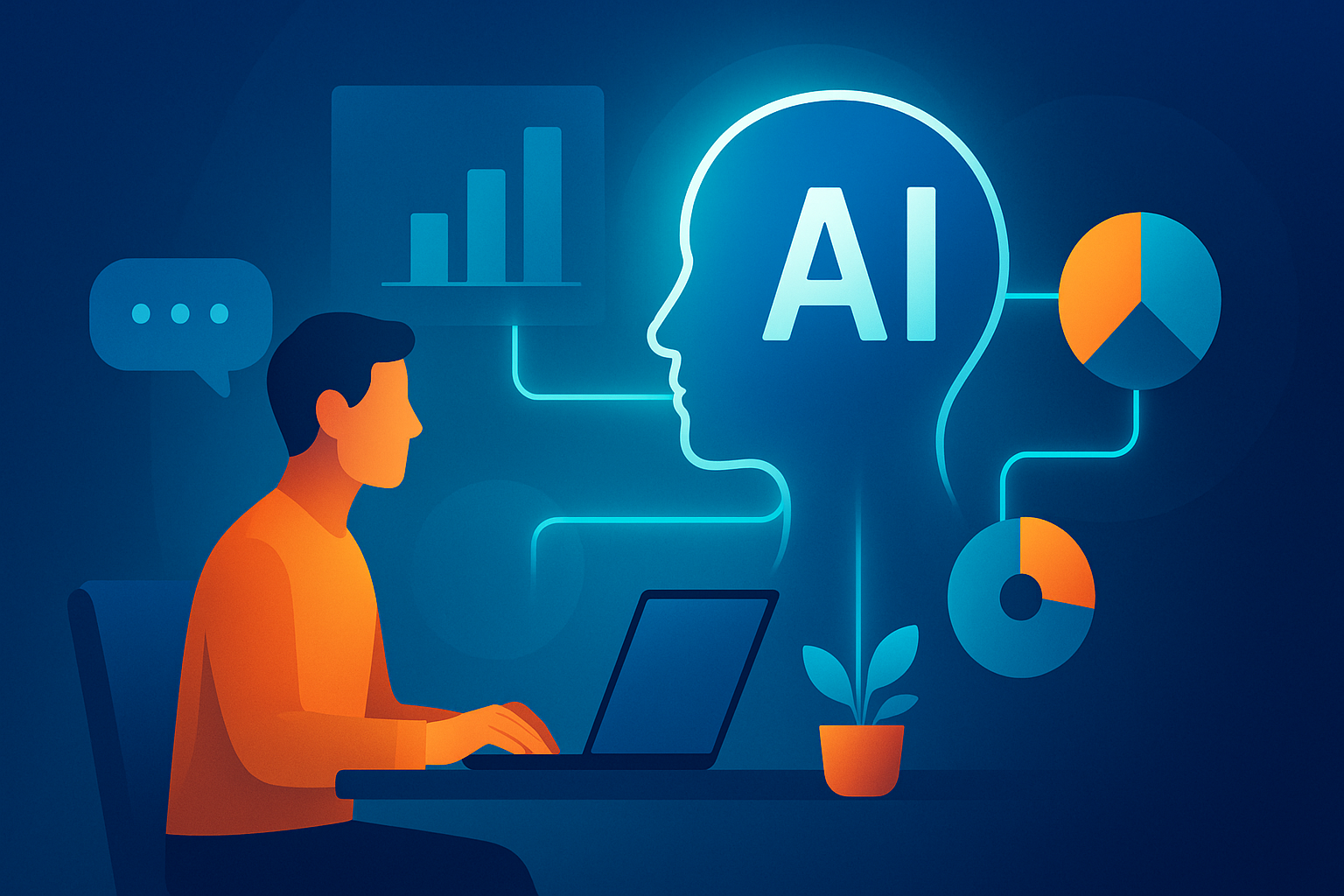
The conversation around Artificial Intelligence has matured. The era of fragmented, standalone AI tools—each promising a narrow fix—is behind us. Businesses now face the reality that genuine AI transformation takes more than simply adding AI to existing processes. It calls for a fundamental shift toward deeply integrated, intelligent environments. This evolution defines the modern AI platform or AI workspace of 2026: a comprehensive ecosystem built for strategic impact, not tactical patches.
Organisations serious about results, particularly in regions like DACH, are moving past the hype to pursue concrete outcomes: streamlined operations, lower costs, stronger compliance, and a sharper competitive edge. The market has decisively shifted toward end-to-end environments where AI collaborates across and within business processes, rather than sitting in isolated silos. As multiple industry analyses note, this integrated approach rests on deeply embedded, multimodal, and agentic AI capabilities, alongside built-in security, robust data governance, and seamless workflow orchestration (Sigma Technology, Inceptive Technologies, Splunk, Deloitte).
Architectural Approaches: What Matters in a Modern AI Platform
When evaluating an AI platform, look beyond surface-level features and concentrate on the architectural pillars that deliver real business value. These are not technological novelties; they are foundational to sustainable, impactful AI integration.
Multimodal Models: The Foundation of Comprehensive Intelligence
Early AI applications often specialised in a single data type – text, images, or structured data. The modern AI workspace leverages multimodal models, which can natively process and combine various data types: text, images, video, code, audio, and structured data (Inceptive Technologies, Splunk). This capability is more than a technical upgrade; it’s a shift in approach. It enables richer, more complex workflows and automation that extends well beyond single-use chatbots or simple content generators. Consider an AI that analyses a customer's textual feedback alongside images of a faulty product and a video of its operation, diagnosing the issue and suggesting a resolution—all within a single environment. This holistic understanding is essential for advanced analytics and real-world reasoning, which drives much broader applicability and deeper insights across an organisation.
Agentic AI & Autonomous Assistants: Moving from Suggesting to Doing
Arguably the biggest shift is the rise of agentic AI. These are not simply tools that suggest; they are autonomous assistants that execute multi-step tasks, interact with APIs, trigger complex workflows, and adapt their actions based on changing contexts (Sigma Technology, Inceptive Technologies, Splunk, Deloitte). This moves AI from a supportive role to an active one, which is essential for generating demonstrable business value and outcome-based ROI. For an AI platform to effectively support agentic AI, its architecture must facilitate seamless orchestration, incorporate fine-grained permissions for control, and maintain reliable state tracking to ensure tasks are completed accurately and securely. This capability is central to automating entire processes, not just individual steps.
Hybrid Edge & Cloud Deployment: Balancing Power, Privacy, and Performance
The notion that all AI must live in the cloud is a marketing myth. A genuinely modern AI workspace offers hybrid deployment, letting models run both in the cloud and on secure local or edge hardware—from laptops to industrial devices (Sigma Technology, Inceptive Technologies, BeyondPLM). This decentralised approach addresses core concerns around data privacy, regulatory compliance, operational resilience, and latency—especially vital for regulated industries and those handling sensitive data. Processing data at the edge reduces dependency on constant cloud connectivity, strengthens security by keeping sensitive information on site, and cuts latency for real-time applications. This flexibility means AI can be deployed wherever it makes the most business sense, without compromise.
Outcome-Based Metrics: TheTrue Measure of AI Value
In the past, AI solutions were often sold on potential or usage. Today, decision-makers and CIOs rightly demand clear, measurable business results. Modern AI platforms are shifting focus to outcome-based metrics, prioritising demonstrable ROI through task completion rates, validated actions, and impact dashboards (BeyondPLM). This means leaving behind seat-based or usage-based licensing in favour of models that prove the platform’s value through concrete efficiency gains, cost reductions, or revenue uplift. Surface-level AI integrations—like slapping on a chatbot without clear performance indicators—face growing scrutiny. What really matters is how an AI workspace directly contributes to strategic business goals.
Essential Features That Distinguish a Future-Ready AI Workspace
Beyond architecture, the practical features of an AI platform determine its usefulness and staying power in an enterprise. These are the capabilities that actually move the needle, not just novelty.
- Deep Interoperability with Enterprise Systems: A modern AI workspace needs to integrate seamlessly with existing enterprise systems—be it ERP, CAD/PLM, HR, CRM, or operational tools—not merely through generic APIs, but with deep contextual awareness. That way, AI can leverage and enrich the vast data already inside your organisation without spawning fresh data silos (Inceptive Technologies, BeyondPLM).
- Role-Based Access and Tiered Productivity: Not everyone interacts with AI the same way. An effective AI platform offers role-based access and tiered productivity: power users get advanced copilots and sophisticated tools, while others use lighter, embedded assistants tailored to their needs. This maximises value without overwhelming people (BeyondPLM).
- Built-in Security and Compliance: As regulations like the EU AI Act evolve, strong security and compliance features are table stakes. This means built-in audit trails, explainability frameworks, and digital provenance for data, ensuring AI operations meet strict legal and ethical standards (Sigma Technology, BeyondPLM, Deloitte).
- Integrated Orchestration Layer: To automate multi-step processes effectively, an AI workspace needs an integrated orchestration layer. This lets you chain various AI agents and tasks into complex business workflows, with feedback loops and human-in-the-loop controls to handle exceptions and maintain oversight (Inceptive Technologies, Splunk, Deloitte).
- On-Premise/Edge Deployment Flexibility: As mentioned, the ability to run AI models on-premise or at the edge remains critical for privacy-sensitive data and regulated industries—a need often overlooked in the rush to generic cloud solutions (Inceptive Technologies, BeyondPLM).
- AI-Driven Development Tools (Low/No-Code): Enabling non-developers and domain experts to build, test, and modify AI workflows through intuitive low-code or no-code interfaces is vital for scaling adoption and making AI accessible across the enterprise (Sigma Technology).
It’s equally worth noting what carries less weight: “one-size-fits-all” AI, for example. The trend is toward domain-specific language models (DSLMs) and vertical solutions, recognising that generalist platforms often lack the precision needed for specific industry challenges (Sigma Technology, Inceptive Technologies). Likewise, while user experience always matters, enterprises generally prioritise backend integration, performance, and security over flashy interfaces.
Integration & Consolidation: Moving Beyond Point Solutions
The fatigue of juggling a sprawling set of disconnected tools—each with its own subscription and integration headaches—has fueled strong demand for consolidation. Organisations now need unified AI workspaces that tackle this complexity head-on.
A truly consolidated AI platform brings together data, models, and workflows in a single, governed environment, removing the need to stitch together a patchwork of disparate tools (Sigma Technology, Inceptive Technologies, Splunk). This encourages cross-functional collaboration—think of a “digital thread” platform where design engineers and compliance officers share real-time data for auditability and productivity (BeyondPLM). Modularity is also essential: plug-and-play AI “skills” or agentic modules let organisations adapt the platform to their unique process details, reducing the risk of excessive vendor lock-in (Inceptive Technologies). Beyond that, embedded intelligence is increasingly powering physical environments such as buildings and factories, taking AI’s reach beyond purely administrative workflows (Sigma Technology, BeyondPLM, Ian Khan).
Take Product Lifecycle Management (PLM). Leading vendors are embedding AI copilots directly into CAD and engineering tools. These copilots run real-time design checks, spot potential flaws, and suggest optimisations. Importantly, these local, edge-based agents are simultaneously linked to cloud-based compliance workflows, delivering immediate productivity at the point of creation together with global oversight and strong audit trails (BeyondPLM). This captures the power of a genuinely integrated AI workspace.
Current Trends & Debates Shaping the AI Landscape
The pace of AI innovation remains rapid, stirring several key trends and critical debates for business leaders:
- Generative AI Operationalisation: The early phase of Generative AI experimentation is quickly yielding to production-scale deployment. By 2026, projections suggest that over 80% of enterprises will be running GenAI applications beyond simple Proofs of Concept (PoCs) (Inceptive Technologies). This demands robust AI platforms that can manage, scale, and govern these sophisticated models.
- Agent-Centred Business Models: The nature of work is shifting from people operating software to AI agents completing tasks autonomously. This profound shift is giving rise to new business models where pricing is increasingly tied to business outcomes rather than traditional seats or licenses (BeyondPLM, Forrester).
- Regulatory and Governance Pressure: Compliance features are no longer optional extras; they are make-or-break factors in AI platform selection. Auditability, explainability, and alignment with evolving AI regulations (especially in the EU and US) are becoming non-negotiable prerequisites for deploying AI responsibly and legally (BeyondPLM, Deloitte).
- Physical AI and Intelligent Infrastructure: AI's influence is spreading beyond digital realms into physical environments. It now covers embedded AI in IoT devices, advanced factory automation, intelligent energy management systems, “smart” workspaces, and even real-time safety systems (Sigma Technology, BeyondPLM, Ian Khan).
- The Concentrated Role of Power Users: While AI promises broad benefits, real productivity gains often concentrate among expert users and orchestrators. AI platforms are being tailored increasingly with both advanced and lighter modes to suit different user profiles, ensuring maximum impact where it counts most (BeyondPLM).
Real-World Applications: Where a Modern AI Workspace Delivers
To grasp the power of a modern AI workspace, consider these concrete examples of how businesses are putting these capabilities to work:
- Smart Workspace Management: Beyond just booking meeting rooms, AI-driven building management systems are optimising energy use, space utilisation, and environmental comfort. Using continuous, agent-like monitoring and control, these systems adjust lighting, heating, and cooling in real time based on occupancy and external conditions, generating significant cost savings and better employee wellbeing (Ian Khan).
- Adaptive Industrial Operations: In manufacturing and logistics, embedded AI in robotics and machinery powers adaptive automation. Rather than rigid programming, these systems learn and adjust to variations in materials, tasks, and environments. Modern AI platforms combine edge AI for immediate, on-site decisions with cloud-based planning and optimisation, creating highly efficient, resilient operational workflows (Sigma Technology, BeyondPLM).
- Compliance-Centric Product Development: For industries with tough regulatory requirements, the ability to demonstrate compliance is paramount. Modern AI platforms are embedding features such as digital provenance, immutable audit trails, and explainable AI workflows directly into product development. This is becoming a key competitive differentiator for clients navigating complex EU/US regulatory landscapes, ensuring every design decision, material choice, and manufacturing step is fully traceable and auditable (BeyondPLM).
Key Takeaways for Your AI Strategy
The path to leveraging AI effectively in 2026 comes down to a few critical insights:
- A modern AI workspace is defined by deep, practical integration. It’s not about layering on AI features; it’s about making intelligence, automation, and governance foundational to how you operate.
- True enterprise adoption calls for hybrid deployment flexibility, strong security, seamless interoperability with existing systems, and—above all—measurable business results that show clear ROI.
- Market leaders combine agentic intelligence, multimodal capabilities, embedded/physical AI, and strong compliance frameworks. They are moving beyond simple “point” solutions to implement AI platforms that fundamentally change how organisations work and compete (Sigma Technology, Inceptive Technologies, BeyondPLM, Splunk, Deloitte, Ian Khan).
The era of fragmented AI solutions and unproven promises is over. To unlock real autonomy, cut costs, and boost efficiency, businesses need to embrace a new generation of AI platforms that are lean, flexible, and built to work smoothly within your existing ecosystem. It’s about creating custom AI solutions that deliver results without disrupting what already works—no vendor lock-in, bloated subscriptions, or typical tool chaos.
Is your organisation ready to move past AI hype and put in place solutions that deliver measurable impact? Explore how a strategic tech partner can help you navigate these complexities and build an AI workspace that genuinely transforms your operations. Contact us today to discuss your unique challenges and how we can help you work smarter.

About the author
Leonhard Geibel
Automation ArchitectGrew up in German industry and learned manual processes from the inside. Then mastered automating them and joined keinsaas to do this at scale.
Connect on LinkedInWhat's next
Ready to build something that fits your team?
Book a free discovery call and we'll map out where custom AI would meaningfully change your week.
Book a discovery call